
A futuristic, glowing compass with a transparent dome displays a blue and pink needle, set on a dark background.
Milena Suter

Vom Buzzword zur Strategie: Der KI-Kompass als Erfolgsschlüssel

Milena Suter UX Designer

14/01/2026 • 5 minutes reading time

How do you get started with AI in your organization?

The technology is promising, competitors are moving fast, and the pressure to launch an AI solution is growing. But one central question often remains unanswered: What exactly is this AI supposed to do?

As soon as the first concrete conversations begin, uncertainty arises. What’s missing is a shared language to express ambitions clearly. Teams talk about AI, but everyone means something different. This often creates a sense of disorientation—not due to a lack of knowledge, but due to a lack of common terms.

When a project starts under these conditions, it tends to go in circles: conflicting expectations, frequent changes of direction, costly iterations, and a growing risk that the final solution is neither user-centered nor brand-aligned. The Massachusetts Institute of Technology (MIT) confirms this: 95% of AI projects fail to deliver results. (source)

Our AI-Compass as Key to Success

To prevent projects from falling into this trap, we developed the AI Compass at Ergosign. Before we start ideating with a client, we sit down for a strategic conversation in a small, focused group.

This is not a technical audit, complex analysis, or AI readiness assessment. It’s a structured, accessible conversation designed to bring clarity before decisions are made.

The AI Compass breaks down early-stage AI use cases into eight strategic dimensions. But its true strength lies not in the dimensions themselves, but in enabling teams to configure them together.
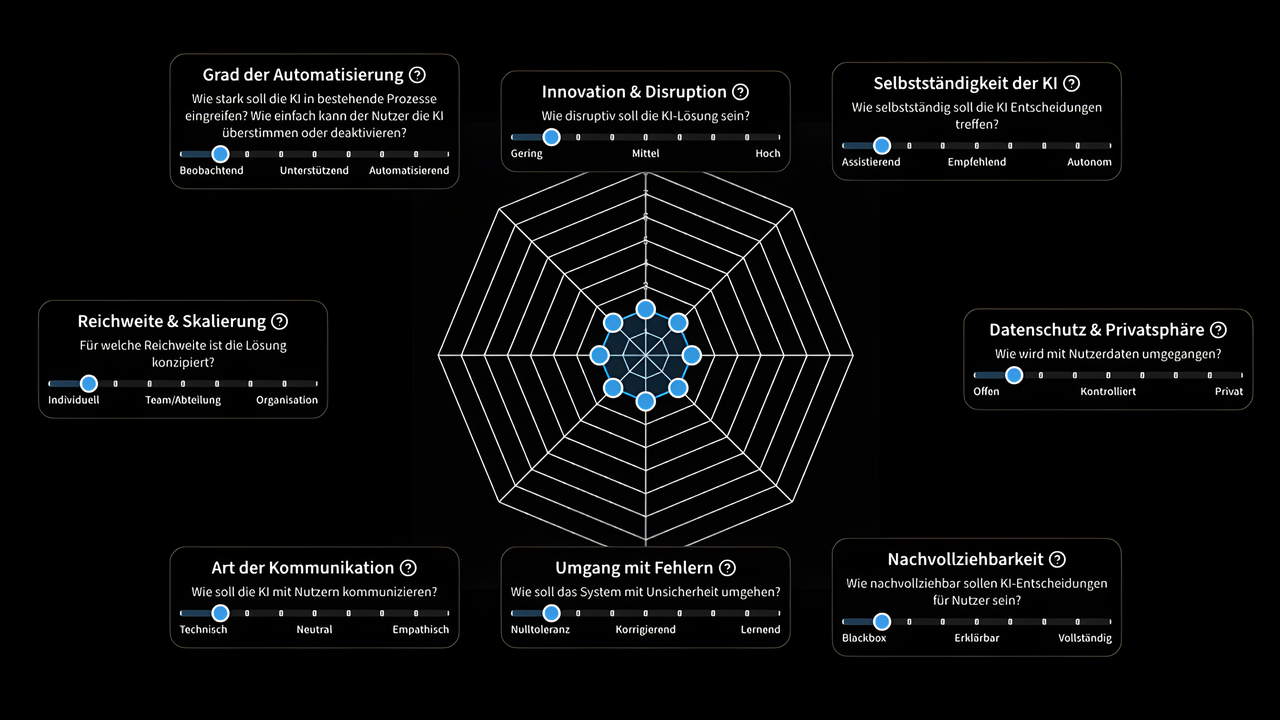
8 central dimensions to score an AI system. Every dimension helps us understand your requirements.

From the very first scale, it becomes clear: teams must take a position. Expectations that were previously unspoken are now out in the open. The team discusses what role the AI should play—and where its boundaries must lie.

This shared reflection creates orientation at a point where decisions are often made on gut feeling. Long before a screen is designed or a concept is written, the team builds a joint understanding of what kind of AI system they want. This early alignment prevents costly detours, direction changes, and inconsistent product decisions.

What’s especially valuable: the conversation requires no technical background. It creates a shared space where management, product, design, engineering, and brand can speak the same language. This makes AI tangible and turns an abstract tech topic into a concrete product vision.

When this language emerges, misunderstandings dissolve. Conflicting goals become visible and can be addressed. The product vision becomes clearer and more realistic. And the development process gains momentum—not from haste, but from clarity. A defined AI profile shortens ideation, prototyping, and alignment significantly because the direction is clear from the start. Uncertainty turns into a shared vision.

A real-world example from the automotive industry

Let’s look at how this works in practice: An automotive company planned to implement an AI feature to assist drivers with maintenance, error messages, and inspections. The idea seemed simple: a “service assistant” offering proactive guidance and usability support.

But in the AI Compass conversation, it quickly became clear: although everyone described the same idea, they had completely different visions.

The product team imagined a self-initiated AI that detects and solves problems. Marketing envisioned a warm, emotional assistant aligned with brand values. The safety team demanded strict boundaries: no automation during driving, full transparency, and traceability. Engineering flagged technical limitations around real-time data and explainability. On paper, the project looked clear. But in reality, there were four distinct product visions.

Configuring the dimensions helped form a shared vision: the AI would not act as a co-pilot or an emotional entity. Instead, the team defined a context-aware service guide that:

  • Becomes proactive only in safe situations

  • Cites sources for every recommendation

  • Doesn’t make decisions on its own

  • Communicates in a neutral, factual tone

  • Operates strictly within safety regulations

No briefing document in the world could have generated this clarity. It emerged through structured discussion—by talking about boundaries, ambitions, concerns, and expectations.

Why our AI Compass works

Our experience—and countless reports from Google, IBM, Microsoft, and independent research groups—show that AI projects rarely fail because of the technology. They fail because of something far more human: unclear requirements, a lack of shared language, and misaligned expectations between business, design, legal, and tech.

After multiple iterations and feedback from experts in IT engineering, data science, development, project management, and UX design, the AI Compass addresses this exact challenge. It translates abstract AI concepts into concrete decisions, aligns all stakeholders, and sets clear boundaries before resources are invested.

Before the first workshop begins, a shared AI profile is defined: a clear understanding of how the system should behave, and what it should not become.

What remains is not a vague hope for "some kind of AI benefit," but a strategic orientation: a project that starts with purpose, focus, and a shared vision.

What the AI Compass delivers

The AI Compass doesn’t deliver a finished concept. It delivers something far more valuable at this stage: a clearly defined AI system profile. A shared understanding of the AI's role, influence, transparency, and boundaries.

This profile is strategic and easy to understand. It’s the ideal starting point for any AI ideation workshop and the foundation for a responsible, user-centered, and brand-aligned AI product. The biggest mistake in AI projects is to start implementation too early. The second biggest is starting without a shared language.

If you want to launch your next AI project with clarity instead of guesswork, let’s align your AI Compass together.

About the author:

As a UX Designer in the AIx Core Team at Ergosign, Milena Suter designs AI-powered solutions—from research to real-world application. With her passion for AI and UX, she creates innovative user experiences and actively shapes the future of design at Ergosign.

Don't leave your next AI project up to chance!

Orientation creates clarity, especially for a topic such as AI. Let's figure set up your AI compass. I look forward to an obligation-free chat.

Milena Suter

Milena Suter

UX Designer